Why Your Dull Knives Are Ruining Holiday Prep and How to Fix Them
The festive season is upon us, a time when our kitchens become bustling hubs of culinary creation. We envision elegant roasts, perfectly diced vegetables, and delicate garnishes, all brought to life with swift, precise movements. Yet, for many of us, this idyllic scene is often marred by a silent saboteur lurking in our knife blocks: dull blades. It is an insidious problem, one that not only frustrates our efforts but also poses a significant, often underestimated, danger. This year, let us vow to banish the dullness and embrace the joy of truly sharp tools, transforming our holiday prep from a chore into the effortless art it should be.
The Hidden Dangers and Inefficiencies of Dull Knives
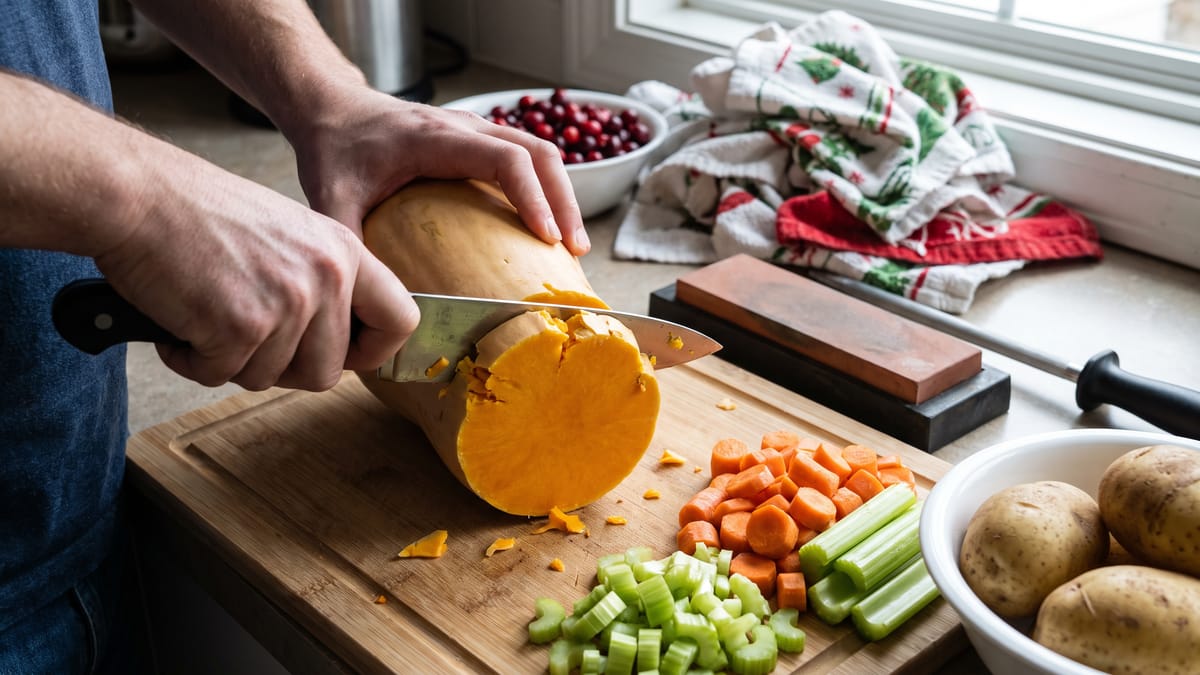
It might seem counterintuitive, but a dull knife is far more dangerous than a sharp one. We often associate sharpness with risk, imagining accidental nicks from a razor-like edge. However, the reality is quite different. A dull blade demands excessive force, requiring up to four times more cutting pressure than a sharp knife. This increased effort leads to fatigue and a crucial loss of control. When a dull knife encounters resistance, it is far more likely to slip off the food's surface, sending your hand or fingers directly into its path. Imagine trying to slice through a slippery sweet potato or a plump turkey breast with a blade that refuses to bite; the risk of a severe cut skyrockets.
Beyond the safety aspect, dull knives are incredibly inefficient and detrimental to the quality of our food. Instead of slicing cleanly, they crush and tear, especially noticeable with delicate ingredients. Think about the bruised, ragged edges of fresh herbs when chopped with a dull blade, or the way a tomato collapses under pressure before finally yielding. This damage extends beyond aesthetics; it breaks down cell walls, accelerating spoilage in fruits and vegetables. Crisp cuts preserve texture and presentation, ensuring our holiday dishes look as good as they taste, while a dull knife leaves us with mangled ingredients, uneven cuts, and a sense of mounting frustration. We also expend far more energy, turning what should be a rhythmic, enjoyable process into a fatiguing battle against our tools.
How to Diagnose a Dull Blade: Simple Home Tests
Before we can fix the problem, we need to accurately identify it. Fortunately, there are several straightforward tests you can perform at home to gauge your knife's sharpness.
The paper test is a classic for a reason. Hold a sheet of printer paper vertically by one edge. With your knife, attempt to slice through the paper from the top, using a single, smooth stroke. A truly sharp knife, like a properly sharpened Global knife with its 15-degree edge per side, should glide through the paper effortlessly, creating a clean cut without snagging, tearing, or bending the paper. If the knife catches, tears, or requires a sawing motion, it is a clear sign that sharpening is in order.
Another excellent indicator is the tomato test. This humble fruit is surprisingly revealing. Place a ripe tomato on your cutting board. A sharp knife will penetrate the skin with minimal pressure, almost sinking into the tomato on contact, allowing you to make a clean slice without crushing the flesh. A dull knife, on the other hand, will struggle to break the skin, often mashing or pushing the tomato around before finally tearing through.
You can also use a visual inspection. Hold your knife under a bright light and examine the cutting edge directly. A truly sharp edge will appear as a thin, dark line, almost invisible. A dull edge, however, will show shiny, reflective spots or a broader, flattened appearance along the cutting surface. These shiny spots indicate a rolled or worn edge that is no longer capable of keen cutting. Finally, the thumbnail test offers a tactile clue: rest the blade at a shallow angle on your thumbnail. A sharp blade will catch or grip slightly, while a dull one will slide smoothly without resistance. If your knife slides over tomato or pepper skin, requires hard pressure to chop onions or carrots, or feels less controlled even after honing, it is definitely time for a refresh.
Honing vs. Sharpening: Understanding the Difference
These two terms are often used interchangeably, but they refer to distinct processes with different goals. Understanding the difference is crucial for proper knife maintenance.
Honing involves realigning a knife's edge. Over time, with use, a sharp knife's microscopic edge can bend or "roll" slightly, becoming misaligned. A honing steel, which is typically a long, ridged rod, does not remove metal; instead, it gently pushes the edge back into alignment. Think of it like straightening a bent wire. Honing is something we should do regularly, perhaps every few uses, to maintain a sharp edge between sharpening sessions. It keeps a sharp knife performing at its best.
Sharpening, conversely, is the process of removing metal from the blade to create a new, fresh cutting edge. When a knife is truly dull, its edge is no longer just rolled; it is worn down, rounded, or even damaged. Honing alone cannot restore this. Sharpening actually grinds away a tiny amount of steel from both sides of the blade, bringing the two surfaces together at a precise angle to form a new, incredibly fine point. This is what truly brings a dull knife back to life.
Simple Sharpening Methods for the Home Cook
The good news is that you do not need to be a professional sharpener to keep your knives in excellent condition. Several accessible and budget-friendly methods are available for home cooks.
Pull-Through Sharpeners: These are perhaps the simplest and most common option for beginners. They consist of slots with abrasive wheels or ceramic rods set at predetermined angles. You simply pull the knife blade through the slots, usually starting with a coarse grit to reshape the edge and finishing with a finer grit to refine it. While incredibly easy to use, they do remove more metal than other methods and can be somewhat aggressive, so use them judiciously. Look for models with both coarse and fine sharpening stages. A good quality pull-through sharpener can be found for a reasonable price and is a great starting point for those intimidated by other methods.
Whetstones (Sharpening Stones): Whetstones offer more control and a superior edge, though they require a bit more practice to master. These rectangular blocks come in various grits, from very coarse to extremely fine. The basic principle involves holding the knife at a consistent angle against the wet stone and moving it back and forth to grind a new edge. We recommend starting with a combination stone, typically featuring a coarse side (around 1000 grit) for initial sharpening and a finer side (around 3000-6000 grit) for refining the edge. There are plenty of online tutorials that can help you learn the correct angles and techniques. While the initial investment might be slightly higher than a pull-through sharpener, a good whetstone will last for years and provide exceptional results.
Electric Sharpeners: These machines take much of the guesswork out of sharpening. They typically feature multiple slots with abrasive wheels that automatically guide the blade at the correct angle. Electric sharpeners are fast and efficient, making them a popular choice for busy home cooks during the holidays. Like pull-through sharpeners, they can be more aggressive with metal removal than whetstones, but modern models often have gentle sharpening stages. They represent a greater initial investment but offer convenience and consistent results.
When to Replace Versus Repair
While most dullness can be remedied with a good sharpening, there are times when a knife might be beyond simple home repair. Examine your blades carefully for signs of severe damage. Deep chips, significant nicks, or a heavily rolled edge that spans a large portion of the blade might require professional attention. A professional sharpener has the specialized equipment and expertise to repair extensive damage, often grinding down the blade to create an entirely new edge.
However, if a knife is very old, has a severely bent tip that cannot be straightened, or if the blade itself is thinning significantly from repeated sharpening, it might be time to consider replacement. Sometimes, the cost of professional repair can approach the cost of a new, decent-quality knife. For cherished or high-end knives, professional repair is often worth the investment. For more budget-friendly or everyday knives, a new purchase might be the more practical solution.
Enhancing Your Holiday Culinary Journey
This holiday season, let us commit to a kitchen where dull knives are a thing of the past. Investing a little time and effort into understanding and practicing proper knife maintenance will not only make your cooking safer and more efficient but also profoundly more enjoyable. Imagine effortlessly gliding through ingredients, creating clean cuts that elevate the presentation and taste of your dishes. A sharp knife is not just a tool; it is an extension of our culinary intent, allowing us to express our creativity with precision and ease. So, before you dive into that festive feast prep, take a moment to test your blades. Your fingers, your food, and your sanity will thank you.
Sources
- • Is It Safe to Use Dull Knives? The Real Risks - MustKitchenBeast
- • Honing Rod
- • How To Test The Sharpness Of A Knife Safely - BPS knives
- • How to Test if a Knife Is Sharp: 7 Fast, Safe Methods
- • Why Sharpen Knives? Better Cuts, Safer Cooking
- • Why Is a Dull Knife More Dangerous? How to Sharpen It (2026)
- • How to Test If Your Knife Is Sharp