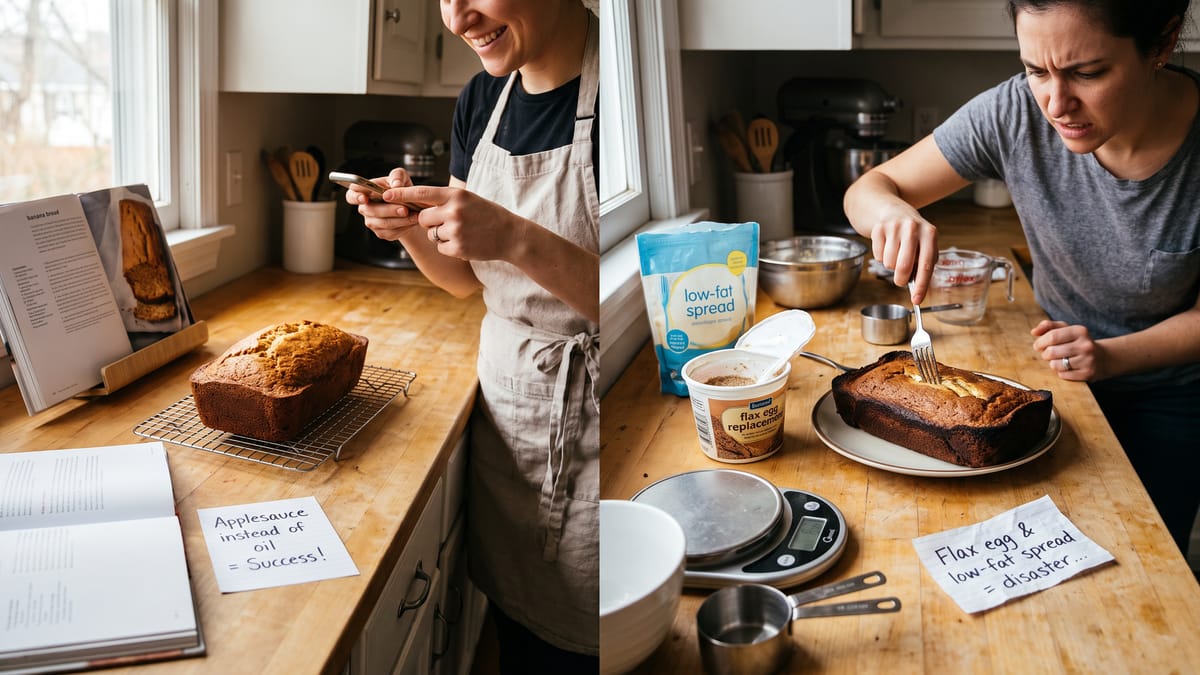
When Recipe Substitutions Work and When They Ruin the Dish
The culinary world, with its endless array of ingredients and techniques, often beckons us to experiment. Sometimes, this spirit of improvisation leads to brilliant discoveries, a stroke of genius born from necessity. Other times, however, it can lead to a spectacular kitchen disaster, a sad testament to a well-intentioned but ill-fated ingredient swap. The truth is, not all substitutions are created equal. While some are culinary lifesavers that seamlessly integrate into a recipe, others fundamentally alter the dish's structure, flavor, or texture, leaving us with a pale imitation of our original intent. Let's delve into the fascinating food science behind common ingredient swaps, uncovering when we can confidently improvise and when it's best to stick to the script.
The Science of Fat: Butter vs. Oil
One of the most frequent dilemmas in the kitchen revolves around fats. Butter, with its rich flavor and unique creaming properties, often stands in contrast to the neutral versatility of oils. Can we truly swap them interchangeably? The answer, as with many things in cooking, is nuanced.
When a recipe calls for melted butter, such as in muffins, quick breads, or oil-style cakes, a neutral oil can indeed be a successful substitute. The key here is the liquid state of the fat. In these scenarios, butter primarily contributes moisture and richness, and its solid structure isn't critical for aeration or lamination. For a seamless swap, we can replace 1 cup of butter with ¾ cup of oil. This ratio accounts for butter's water content, ensuring the final product isn't overly greasy. The result will be a slightly moister crumb and a less pronounced buttery flavor, but the overall structure and texture will remain largely intact.
However, the story changes dramatically when a recipe relies on solid butter. Think of flaky croissants, delicate puff pastry, or tender biscuits. These culinary marvels depend on the unique properties of solid butter. During baking, the butter melts, releasing steam that creates distinct layers and a light, airy texture. Oil, being liquid at room temperature, cannot replicate this lamination process. Attempting to substitute oil for solid butter in such recipes will result in a dense, greasy, and utterly disappointing product, devoid of the characteristic flakiness we crave. While vegan block fats can offer a partial solution in a pinch, they rarely achieve the identical results of traditional butter in these intricate doughs.
The Acid Test: Buttermilk and Its Clever Stand-ins
Buttermilk, with its tangy flavor and acidic properties, is a cornerstone in many beloved recipes, from fluffy pancakes to moist soda bread. But what if our fridge is bare? Thankfully, this is one area where a simple substitution shines.
The magic of buttermilk lies in its acidity, which reacts with baking soda to produce carbon dioxide, giving baked goods their lift. We can easily create a reliable buttermilk substitute by combining 1 cup of whole milk with 1 tablespoon of lemon juice or white vinegar. After a quick stir, let it stand for 5-10 minutes until it visibly curdles. This homemade version perfectly mimics the acidity of store-bought buttermilk and works beautifully in pancakes, scones, soda bread, and cakes. The slight curdling indicates the acid has begun to react with the milk proteins, creating a similar texture and functionality.
Similarly, Greek yogurt and sour cream are often interchangeable in recipes for baked goods and dips, offering a similar tangy profile and creamy texture. They can be swapped 1:1. If a recipe specifically calls for the pourable consistency of sour cream, we can simply thin out Greek yogurt with a splash of milk to achieve the desired flow.
Flour Power: Navigating the Complexities of Structure
Flour is the backbone of countless dishes, and its type dictates the final texture and structure. Substituting flours can be a high-stakes game, particularly when it comes to gluten.
For recipes requiring a finer, more tender crumb, cake flour is often specified. Its lower protein content results in less gluten formation, leading to a softer texture. If we don't have cake flour on hand, we can easily create a suitable substitute from all-purpose flour. For every cup of all-purpose flour, remove 2 tablespoons and replace them with 2 tablespoons of cornstarch. Sift this mixture twice to ensure even distribution, and voilà, we have a functional equivalent for cake flour. The cornstarch helps to dilute the gluten-forming proteins, mimicking the properties of true cake flour.
Self-rising flour is another common ingredient that's simple to replicate. For every cup of all-purpose flour, add 1½ teaspoons of baking powder and ¼ teaspoon of salt. This blend is identical in function and works perfectly for biscuits, scones, and quick breads, providing both structure and leavening.
When venturing into whole-wheat flour, caution is advised. While it offers a nutritional boost and a pleasant nutty flavor, its higher bran and germ content can interfere with gluten development, leading to denser results. We can generally replace up to 30% of all-purpose flour with whole-wheat flour without significant structural changes. Beyond that, expect a noticeably denser product. To mitigate this, we should add 1-2 tablespoons of extra liquid per cup of whole-wheat flour substituted, as it absorbs more moisture than all-purpose flour.
The realm of gluten-free baking presents the most significant challenge for substitutions. Gluten, the protein network formed when wheat flour is mixed with liquid, provides structure and elasticity. Single gluten-free flours, such as almond or coconut, lack this crucial component and possess wildly different absorbency rates. Simply swapping them volume-for-volume with wheat flour is a recipe for disaster. Successful gluten-free baking relies on commercial 1:1 blends that meticulously combine various rice flours, starches, and binders like xanthan gum to approximate the functional properties of wheat flour. Coconut flour, in particular, is an extreme outlier; it absorbs liquid exceptionally well and cannot be swapped by volume for any other flour. Any recipe using coconut flour must be developed specifically for it, with its unique liquid and egg ratios.
The Binding Agents: Eggs and Their Many Roles
Eggs are multifaceted ingredients, contributing moisture, richness, leavening, and binding properties. Their role in a recipe dictates the success of any substitution.
For recipes where eggs primarily act as a binder and provide moisture, such as muffins, quick breads, brownies, and pancakes, several substitutes can work. One large egg can be replaced by ¼ cup of mashed banana, applesauce, or plain yogurt. Alternatively, a "flax egg" made from 1 tablespoon of ground flaxseed mixed with 3 tablespoons of water, allowed to sit until gelled, also serves as an effective binder. These substitutes are excellent for adding moisture and holding ingredients together.
However, these egg substitutes fall short in recipes where eggs play a more structural or emulsifying role. They are unsuitable for custards, quiches, sponge cakes, or any recipe that calls for three or more eggs, where the egg's ability to create a stable foam or set a delicate custard is paramount. In these instances, the unique protein structure of eggs is irreplaceable.
Leavening and Cream: Crucial Chemical Reactions
Leavening agents and dairy products often involve specific chemical reactions that are vital to a dish's outcome.
If we're out of baking powder, a simple swap involves baking soda and cream of tartar. One teaspoon of baking powder can be replaced by ¼ teaspoon of baking soda combined with ½ teaspoon of cream of tartar. The cream of tartar, an acid, reacts with the baking soda to produce the necessary carbon dioxide for lift.
For heavy cream in cooking applications, where whipping isn't required, we have a few options. A homemade substitute can be made by whisking ¾ cup of whole milk with ¼ cup of melted butter. Alternatively, 1:1 crème fraîche or mascarpone, loosened with a splash of milk to achieve the desired consistency, also works well, adding a rich, creamy texture.
Putting It All Together
The art of successful recipe substitution hinges on understanding the fundamental role each ingredient plays. Is it providing moisture, structure, acidity, or leavening? When we can replicate that functional role, our chances of success skyrocket. Reliable swaps like turning milk into buttermilk, creating cake flour from all-purpose, or using oil for melted butter capitalize on this principle. However, when an ingredient's unique properties, such as gluten formation, the creaming ability of solid butter, or the specific protein structure of multiple eggs, are critical, attempting a direct substitution is often an exercise in futility. Embrace the science, understand the function, and we'll be well on our way to becoming master improvisers in the kitchen.
Sources
- • Ingredient Substitutes for Eggs, Dairy and Flour
- • Substitution rules for missing ingredients
- • Home Cooks: Exact Ratios for Ingredient Substitutions with Converters
- • Cooking Substitutes: How Swaps Actually Work
- • Substitutions in Baking That Actually Work: What You Can Swap Without Ruining Your Recipe