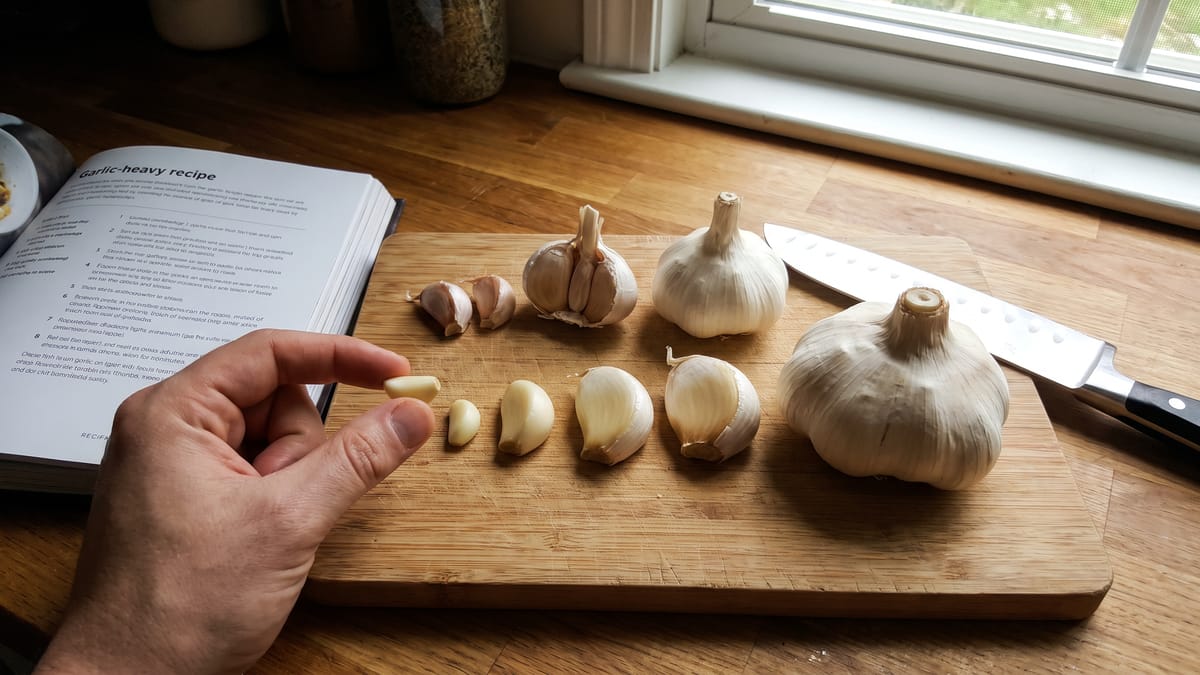
What One Clove of Garlic Actually Means When Sizes Vary Wildly
Garlic, that pungent, aromatic cornerstone of countless cuisines, holds a revered place in our kitchens. It transforms simple ingredients into something extraordinary, lending depth, warmth, and a zesty kick to everything from a slow-simmered ragu to a vibrant stir-fry. Yet, despite our collective adoration, garlic presents a curious conundrum to the home cook: the elusive "one clove" measurement. We've all been there, staring at a recipe that calls for "two cloves of garlic," only to find ourselves holding a bulb containing cloves ranging from tiny slivers to hefty, thumb-sized segments. What, precisely, does "one clove" actually mean in such a wildly inconsistent landscape? This seemingly minor detail can dramatically alter the flavor profile of a dish, tipping it from subtly fragrant to overwhelmingly garlicky. Today, we're going to demystify the humble garlic clove, dissecting its anatomy, exploring the vast spectrum of its size variations, and equipping you with the knowledge to achieve perfect garlic balance every time.
The Anatomy of a Garlic Bulb and the Enigma of Clove Size
Before we delve into measurements, let's appreciate the structure of a garlic bulb itself. What we typically buy is a compound bulb, a papery sheath encasing numerous individual cloves, each a miniature bulb in its own right, ready to sprout if given the chance. These cloves are not uniform. Think of a cross-section of a garlic bulb, and you'll notice a distinct pattern: the outer cloves tend to be larger, plumper, and often a bit drier, while the inner cloves are generally smaller and possess a higher moisture content. This natural variation is further amplified by the sheer diversity of garlic cultivars. A garlic bulb typically contains 10–14 cloves, though some varieties yield as few as 4–6 (such as elephant garlic) or as many as 20 small cloves. Elephant garlic, despite its name, is not true garlic but a type of leek, and its colossal cloves are an entirely different beast altogether.
This inherent variability means that "one clove" is not a standardized unit of measurement. It's a botanical term, a descriptor of a segment of the bulb, not a precise culinary metric. The weight of a single clove can swing wildly, from a mere 1.2 grams for a small 'button' clove to a substantial 14 grams or more for an extra-large one. This staggering difference, sometimes a variation of up to 300% across common cultivars, growing conditions, and even storage durations, is precisely why relying solely on a count of cloves can lead to unpredictable results in our cooking.
The Unreliability of Volume and the Supremacy of Weight
Given the dramatic size differences, it becomes clear why volume measurements, such as teaspoons of minced garlic, also fall short of true accuracy. While a typical medium clove, weighing approximately 3 to 5 grams, might yield roughly ½ to 1 teaspoon of minced garlic, this too is subject to interpretation and technique. How finely you mince, chop, grate, or press your garlic significantly impacts the volume it occupies. For instance, the same 4.5 grams of garlic that might give you ½ to ¾ teaspoon when finely minced could yield a mere ¼ to ⅓ teaspoon if grated, or perhaps ⅓ to ½ teaspoon when put through a garlic press. The density and air pockets created by different preparation methods mean that even a seemingly precise volume measurement isn't as reliable as we might hope.
This is where the concept of weight steps in as our culinary savior. In the world of professional kitchens, where consistency and reproducibility are paramount, weight is king. A medium clove is often defined as weighing between 3.5 and 5.2 grams, typically measuring about 1.5 to 2 centimeters wide and 2.5 to 3.2 centimeters long, and yielding approximately 1 teaspoon of finely minced garlic. For the home cook aspiring to greater accuracy, especially with recipes that demand precise flavor balance, investing in a kitchen scale is a game-changer. Five grams of fresh garlic will always be five grams of fresh garlic, regardless of whether it comes from one large clove or several smaller ones. This consistency is the only trustworthy baseline for ensuring your dishes taste the same every time you make them, allowing you to truly understand and replicate the intended flavor profile.
Debunking the GMO Myth: Garlic's Natural Diversity
When confronted with such wide variations in garlic clove size, some might jump to conclusions about genetic modification. Let's put that myth to rest. The diverse sizes and shapes of garlic cloves we encounter are a testament to natural variation, selective breeding over millennia, and environmental factors, not genetic engineering. Garlic is a fascinating plant with a long history of cultivation, dating back thousands of years. It reproduces vegetatively, meaning new plants grow from cloves, rather than from seeds. This method of propagation naturally leads to a vast array of distinct cultivars, each with its own unique characteristics, including clove size, skin color, pungency, and storage life.
Growing conditions play an enormous role as well. Factors such as soil quality, nutrient availability, water levels, temperature fluctuations, and even the amount of sunlight a plant receives can all influence the size and development of the cloves within a bulb. A well-nourished plant grown in ideal conditions will naturally produce larger, more robust cloves than one that is stressed or grown in poor soil. Therefore, the varying sizes we see in our garlic are a celebration of its natural diversity and resilience, a product of careful cultivation and nature's own hand, not a result of laboratory intervention.
Practical Tips for Perfect Garlic Every Time
So, what does this mean for our everyday cooking? How can we navigate the "one clove" dilemma with confidence?
- • Embrace the Scale: If a recipe is particularly sensitive to garlic levels, or if you're developing your own recipes, use a kitchen scale. It's the most reliable way to ensure consistent results. As a general guideline, 5 grams of fresh garlic is a good starting point for what many consider a "medium" amount, yielding roughly 1.3 teaspoons when minced.
- • Taste as You Go (with Caution): For dishes where garlic is added early in the cooking process, like a sautéed mirepoix, you can often add garlic in stages. Start with what you think is a reasonable amount, and if the dish tastes like it needs more depth later, you can always add a bit of garlic powder or even more fresh garlic if appropriate.
- • Understand Pungency and Allicin: The active compound responsible for garlic's distinctive flavor and many of its health benefits is allicin. The amount of allicin scales with clove size, meaning a larger clove will contain significantly more of this pungent compound. A small clove might have around 1.8 mg of allicin, while an extra-large one could pack up to 11.3 mg. This is why a recipe calling for "one clove" can taste wildly different depending on the size of the clove you choose.
- • Consider Garlic Powder Equivalence: For times when you're out of fresh garlic or need a milder, more diffused garlic flavor, garlic powder is a useful substitute. A good rule of thumb is that 1 medium clove (approximately 3 grams) is roughly equivalent to ¼ teaspoon of garlic powder. If a recipe calls for 1 tablespoon of minced garlic (which is about 3 medium cloves or 9 grams), you'd use roughly ¾ teaspoon of garlic powder.
- • Adjust to Your Preference: Ultimately, cooking is an art, and personal taste reigns supreme. If you adore garlic, feel free to add an extra small clove or two. If you prefer a more subtle hint, err on the side of caution. The goal is to understand the variables so you can make informed decisions that align with your palate.
Putting It All Together
The journey to mastering garlic in the kitchen is one of awareness and adaptation. The next time a recipe asks for "one clove," remember that this isn't a fixed, immutable quantity. It's a suggestion, a starting point that invites us to consider the size of the cloves in our hands, the desired intensity of flavor, and the overall balance of the dish. By understanding the natural variations in garlic, appreciating the precision that weight measurements offer, and letting our taste buds be our guide, we can move beyond the ambiguity of the "one clove" and confidently wield this magnificent ingredient to create consistently delicious meals. So go forth, embrace the beautiful diversity of garlic, and infuse your cooking with its incomparable magic.
Sources
- • You've Been Counting Garlic Cloves Wrong (Science Says So)
- • 1 Clove Garlic: Exact Measurements And Uses
- • 1 Clove Garlic: Exact Weight, Equivalents & Usage Guide
- • Faq: Your Garlic Measurement...
- • How Big Is 1 Clove Of Garlic: A Practical Guide - Alibaba.com
- • How Much Is A Garlic Clove? Exact Weight & Volume Guide
- • 1 Clove Of Garlic Equals: When Size Matters (And When It Doesn't)