What Are Entremets and Why French Pastry Students Spend Weeks Mastering Them
Stepping into the hallowed halls of a French pastry school is an exhilarating experience, a journey where the aroma of melting chocolate mingles with the precise hum of stand mixers. Among the myriad of exquisite creations students learn to master, one particular dessert stands as a true testament to skill, patience, and scientific understanding: the entremet. If you've ever gazed longingly at a pâtisserie window, captivated by a flawlessly glazed, jewel-toned cake, chances are you've encountered an entremet. These aren't just cakes; they are edible architecture, a symphony of textures and flavors meticulously composed in layers. And for aspiring French pastry chefs, dedicating weeks to their mastery is not just a tradition, it's an absolute necessity.
Deconstructing the Entremet: A Layered Masterpiece
So, what exactly is an entremet? At its heart, an entremet is a modern French layered mousse cake, a sophisticated dessert built from distinct components. Imagine a cake that transcends the ordinary, where each slice reveals a cross-section of perfectly aligned, vibrant strata. Unlike a simple layer cake, an entremet is typically assembled upside-down in a ring mold or silicone form, frozen solid, and then adorned with a show-stopping glaze. This seemingly complex process is what allows for the incredible precision and visual appeal that defines these desserts.
Let's break down the standard structure, moving from the base upwards as it would be eaten, though remember, it's often built in reverse. First, you'll find a thin sponge or biscuit base, perhaps a delicate joconde, a nutty dacquoise, or a buttery sablé breton. This provides a stable foundation and a contrasting texture. Next often comes a crunch layer, adding an exciting textural counterpoint. Think of praline mixed with crispy feuilletine or a delightful streusel. These layers are all about providing a dynamic eating experience.
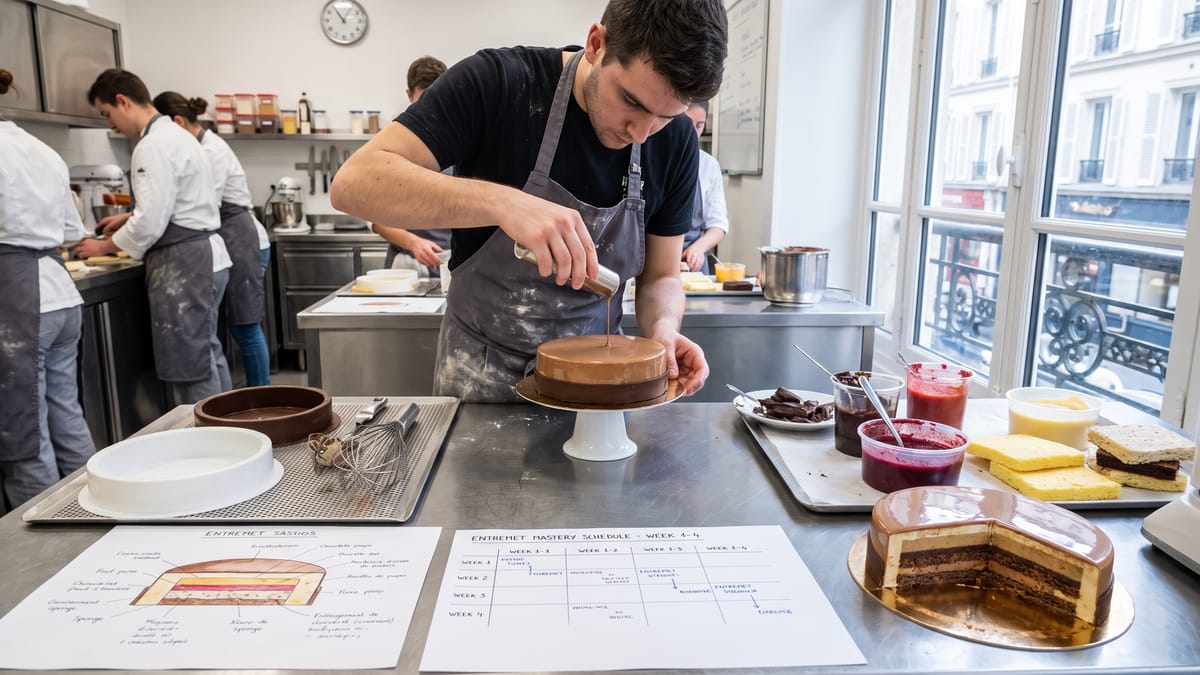
The core of an entremet is its mousse body, which can be crafted from chocolate, fruit purées, or rich creams, all set with gelatin to achieve that characteristic airy yet stable texture. Embedded within this mousse, or sometimes as a distinct layer on its own, is one or more frozen inserts. These inserts are where much of the flavor complexity often lies, ranging from a crémeux, a namelaka, a vibrant compote, or a fruit jelly. Each insert is made and frozen separately, a critical step we’ll delve into shortly. Finally, the entire frozen cake is enrobed in a mirror glaze, known as glaçage miroir, or sometimes a velvet spray finish, which provides that iconic, flawless sheen.
The Art of Assembly: Building from the Inside Out
The construction of an entremet is a masterclass in controlled chaos, or rather, incredibly precise order. Each component is prepared individually. The sponge is baked, the crunch layer is mixed, the mousse is whipped, and the inserts are cooked and poured into smaller molds to freeze solid. This pre-freezing of inserts is crucial; it prevents them from bleeding into the mousse when they are incorporated, ensuring those clean, distinct lines in the final slice.
The magic truly happens during assembly. Often, a student will line a ring mold with acetate, then pipe a layer of mousse. Into this, a perfectly frozen insert is carefully placed, sometimes topped with more mousse, and then the crunch layer and sponge base are added, inverting the final eating order. The entire cake is then frozen solid, a non-negotiable step that typically requires at least 4 hours, though 12 hours is ideal. This deep freeze ensures the cake is utterly stable and ready for its glamorous finish.
One of the most critical aspects of this assembly is temperature control, particularly for the mousse. Mousse must be poured at a precise 28–32°C. Pour it too warm, and it risks melting the pre-frozen insert, leading to messy, undefined layers. Pour it too cool, and it can trap air bubbles, compromising both the texture and the clean layer definition that entremets are celebrated for. This narrow temperature window is where the student's understanding of food science, specifically gelation and emulsion stability, truly comes into play.
The Mirror Glaze: A Veil of Perfection
The mirror glaze is arguably the most visually striking element of an entremet. It's not just for show; it's a testament to the pastry chef's technical prowess. This glossy finish is an emulsion, typically made from white chocolate, gelatin, condensed milk, sugar syrup, and water. The mixture is heated to a precise 103°C, then cooled to a specific pouring temperature of 33–35°C. This narrow temperature range is vital. Pour it too hot, and it will be too thin, running off the cake; too cold, and it will be too thick, creating an uneven, lumpy surface.
The moment of truth arrives when the perfectly tempered glaze is poured over the deeply frozen entremet. The instant contact between the warm glaze and the icy cake creates a phenomenon called thermal shock. This shock causes the glaze to set almost immediately, forming that characteristic reflective, bubble-free skin. It's a breathtaking transformation, turning a frozen block into a glistening gem. While glazes add little to no flavor, their role is to act as a beautiful, flawless veil, concealing the intricate interior and captivating the eye. Achieving a glaze that is free of bubbles and lumps, and that maintains its shine even after refrigeration, is a skill honed over many attempts.
Precision in Every Slice: The Science of Structure
Beyond the visual appeal, the true mark of an expertly crafted entremet lies in its integrity when sliced. A clean slice, where each layer is distinct, firm, and doesn't bleed into its neighbors, is the ultimate goal. This requires a delicate balance of ingredients and techniques. The gelatin ratios in the mousse and inserts must be exact; too much, and the texture becomes rubbery, too little, and the layers collapse. The base must be rigid enough to support the structure, and crucially, the layers must bond while the mousse is still fluid so they freeze as one cohesive body.
Consider the lining sponge, often a joconde or ladyfinger. It serves a dual purpose: it separates the mousse from an insert, preventing undesirable interaction, and it's often brushed with a flavored syrup. This syrup helps it absorb moisture, ensuring its hydration level matches the surrounding creams, contributing to a harmonious texture throughout the cake.
When you look at competition-standard entremets, such as those showcased at the Coupe du Monde de la Pâtisserie, you'll often find 5 to 7 distinct layers, each offering a different texture and flavor profile. These are assembled with sub-millimeter precision, a testament to the rigorous training students undergo. Every millimeter matters, every temperature point is crucial, and every ingredient is chosen for a specific purpose.
The Evolution of Elegance: A Modern Phenomenon
It's fascinating to consider that the modern entremet, as we know it today, barely existed before the 1980s. This genre was pioneered by visionary chefs like Gaston Lenôtre and later refined by culinary icons such as Pierre Hermé and Christophe Felder. What started as an innovative approach to dessert making has now become a dominant force in French pâtisserie windows, international competitions, and, naturally, the curriculum of every serious pastry school.
Mastering entremets is not just about following a recipe; it's about understanding the underlying food science. It's about knowing why certain temperatures are critical, how gelatin behaves, and how to create stable emulsions. It's about developing an acute sense of timing, a steady hand, and an artist's eye for detail. Students spend weeks grappling with these complexities, because the entremet demands nothing less than perfection.
Putting It All Together: The Enduring Legacy of Entremets
The journey to mastering entremets is arduous, demanding endless practice, meticulous attention to detail, and a deep understanding of culinary chemistry. But the rewards are immense. For a French pastry student, successfully creating a flawless entremet is a badge of honor, a demonstration of their comprehensive skill set. It proves their ability to manage multiple complex preparations simultaneously, to work with extreme precision, and to transform raw ingredients into a breathtaking, multi-sensory experience.
For us, the home bakers and appreciative eaters, understanding the complexity behind these exquisite creations deepens our admiration for the pastry chefs who bring them to life. While making a competition-level entremet at home might seem daunting, the principles of precise measurement, temperature control, and thoughtful layering are valuable lessons that can elevate any baking endeavor. So, the next time you encounter an entremet, take a moment to appreciate not just its beauty and taste, but the weeks of dedication, the scientific rigor, and the artistic vision that went into its creation. It's a true celebration of culinary artistry.