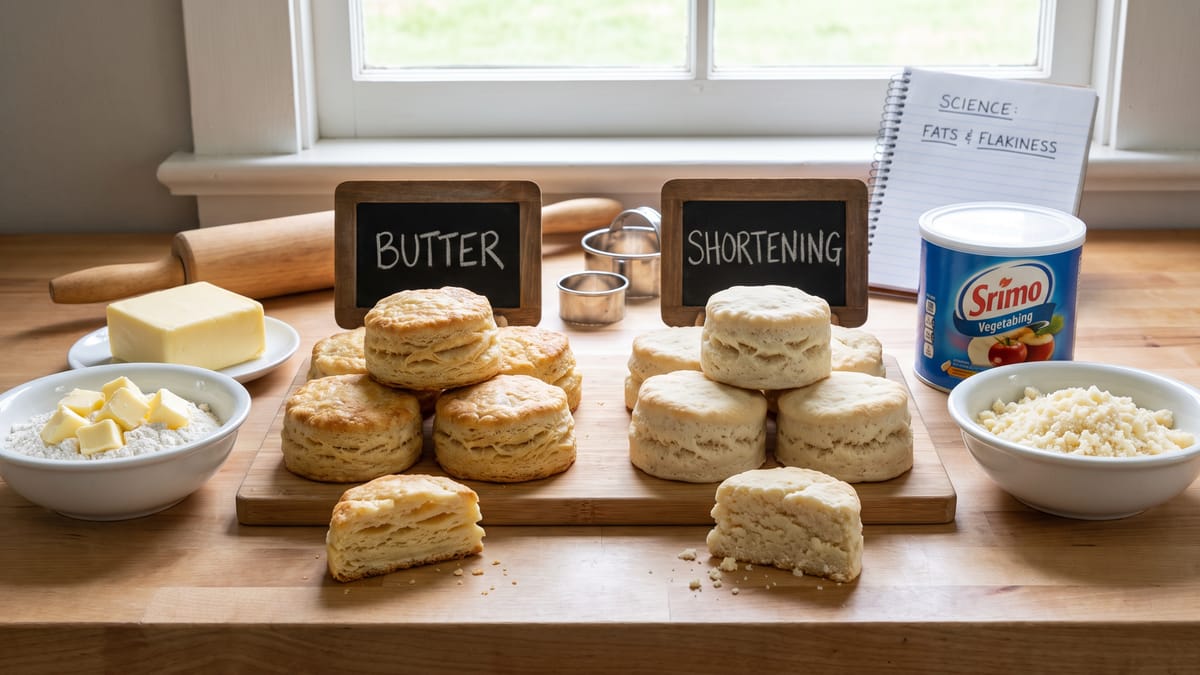
Should You Use Butter or Shortening for Flaky Biscuits? The Science Behind the Choice
The pursuit of the perfect biscuit is a culinary odyssey for many home bakers. We dream of those ethereal layers, that tender crumb, and a flavor that speaks of comfort and tradition. At the heart of this quest lies a fundamental question: what fat should we use? For generations, bakers have debated the merits of butter versus shortening, each championing their preferred ingredient for its unique contributions. But beyond personal preference, there's a fascinating world of food science at play, dictating how these fats interact with flour and heat to shape the final texture and taste of our beloved biscuits. Today, we're going to delve deep into that science, unraveling the mysteries behind flakiness, tenderness, and flavor to help you make an informed choice in your own kitchen.
The Great Fat Divide: Butter's Flavor Versus Shortening's Stability
Before we dissect the scientific nuances, let's acknowledge the primary arguments typically made for each fat. Butter, with its golden hue and unmistakable aroma, is lauded for the rich, nuanced flavor it imparts. It's the taste of tradition, the essence of a truly indulgent biscuit. Shortening, on the other hand, often gets the nod for its ability to produce an exceptionally tender crumb and, some argue, a more pronounced flakiness due to its unique properties. It's also known for being more forgiving to work with, especially for those new to biscuit making.
But are these perceptions entirely accurate? And what does "flaky" truly mean in the context of a biscuit? For us, it conjures images of distinct, delicate layers that separate easily when pulled apart, almost like pages in a book. "Tender," conversely, refers to how easily the biscuit yields to the bite, its crumb soft and yielding rather than tough or chewy. The interplay between these two desirable qualities is where the science of fats truly shines.
Deconstructing Butter: The Magic of Water and Milk Solids
Let's start with butter, a dairy fat that is far more complex than it might appear. When we reach for a stick of cold butter, we're not just grabbing pure fat. Butter is typically composed of about 80% fat, but crucially, it also contains 16-18% water and 2-4% milk solids. It's these seemingly small percentages of non-fat components that hold the key to butter's distinctive role in biscuit making, especially when it comes to flakiness and flavor.
The water content in butter is the primary driver of those coveted flaky layers. When cold butter is cut into flour and then introduced to the heat of the oven, something remarkable happens. As the temperature rises, the water trapped within those tiny pieces of butter rapidly converts into steam. This steam, seeking to escape, forcefully pushes apart the layers of dough, creating delicate air pockets and separating the gluten networks. This process, often referred to as lamination in a simpler form than with puff pastry, is what gives butter-based biscuits their signature rise and distinct, flaky architecture. Without this internal steam production, the dramatic separation of layers simply wouldn't occur to the same extent.
The milk solids in butter also play a vital, though different, role. These solids undergo the Maillard reaction, a complex chemical process responsible for the browning and development of savory, rich flavors in many cooked foods. As the biscuit bakes, these milk solids caramelize and deepen in color, contributing to the golden-brown crust and the wonderfully complex, nutty, and buttery flavor profile that we associate with a truly exceptional biscuit. Shortening, lacking these milk solids, cannot achieve this depth of flavor or natural browning on its own.
Another critical factor with butter is its melting point. Butter melts at a relatively low temperature compared to shortening. This means that if our dough isn't kept sufficiently cold during preparation, the butter can melt and smear into the flour before it even hits the oven. When this happens, the distinct pockets of butter that are essential for steam creation are lost, resulting in a biscuit that is less flaky and potentially more dense. Furthermore, its lower melting point can cause butter biscuits to spread more in the oven if the dough is not kept very cold, leading to a thinner profile.
Unpacking Shortening: The Power of Pure Fat
Now, let's turn our attention to shortening. Unlike butter, shortening is an almost entirely pure fat, typically 100% fat with virtually no water or milk solids. This fundamental difference is what dictates its unique contribution to biscuit texture. Because shortening contains no water, it generates no steam during baking. This means the primary mechanism for creating dramatic, separate layers, as seen with butter, is absent.
Instead, shortening's strength lies in its ability to inhibit gluten formation and create an exceptionally tender crumb. Gluten, formed when water interacts with proteins in flour, provides structure and elasticity to dough. While some gluten development is desirable for structure, too much can lead to a tough biscuit. Shortening, being pure fat, coats the flour particles more completely and efficiently than butter. This comprehensive coating acts as a barrier, preventing water from fully interacting with the gluten-forming proteins. The result is "shortened" gluten strands, meaning they are less developed and therefore produce a more tender, crumbly texture. This is why shortening-based biscuits are often described as having a softer, almost cake-like crumb.
Shortening also boasts a higher melting point than butter. This means it stays solid longer in the oven, providing structural stability to the biscuit dough as it bakes. This can be an advantage for ease of handling, as the dough is less prone to becoming sticky or losing its shape. However, because it doesn't melt and release water to create steam pockets, the rise in shortening-based biscuits tends to be less dramatic, and the flakiness is generally less pronounced compared to those made with butter. The texture, while tender, will be more uniform throughout, without the distinct, separable layers.
From a visual standpoint, biscuits made with shortening tend to be paler in color due to the absence of milk solids that undergo the Maillard reaction. To achieve a golden hue, bakers often brush shortening biscuits with melted butter or an egg wash before baking.
The Gluten Conundrum: How Fats Control Dough Development
To truly understand the impact of butter and shortening, we need to briefly touch upon gluten. Gluten is the protein network that gives baked goods their structure. When flour is mixed with water, these proteins, glutenin and gliadin, link together to form gluten. Kneading or excessive handling strengthens this network, which is great for chewy breads but less desirable for tender biscuits.
Both butter and shortening work to inhibit gluten development, but they do so in slightly different ways. As we discussed, shortening's pure fat content and its ability to coat flour particles thoroughly make it incredibly effective at "shortening" gluten strands, resulting in a very tender product. Butter also inhibits gluten, but its water content means it doesn't coat the flour quite as comprehensively, allowing for a bit more gluten development. However, the cold, solid pieces of butter are crucial; they create pockets within the dough where gluten development is minimal, further contributing to tenderness once the butter melts away.
The Verdict: Butter for Flakiness, Shortening for Tenderness, and the Best of Both Worlds
So, after dissecting the scientific properties of each fat, which one reigns supreme for flaky biscuits?
Our verdict, firmly rooted in food science and backed by generations of baking wisdom, is this: Butter creates flakier biscuits because its 16-18% water content turns to steam during baking, puffing apart dough layers. Shortening, being 100% fat with no water, yields a more tender, crumbly texture with less dramatic flakiness but offers superior handling stability.
For maximum flakiness and that unparalleled rich, golden-brown crust and flavor, cold butter is your champion. The distinct solid pieces of very cold butter, when cut into the flour, melt in the oven, leaving voids that are then filled with steam, creating those beautiful, separated layers. Liquid fats simply cannot replicate this effect.
However, if your priority is an incredibly tender, soft, and easy-to-handle dough, shortening is an excellent choice. Its ability to thoroughly coat flour particles and inhibit gluten formation results in a biscuit with a delightfully short and crumbly texture.
Practical Tips for Maximizing Your Chosen Fat
Regardless of your primary fat choice, here are some actionable tips to elevate your biscuit game:
Working with Butter for Ultimate Flakiness
- • Keep it Cold, Colder, Coldest: This is paramount. We cannot stress enough the importance of using very cold butter, straight from the refrigerator, or even briefly chilled in the freezer. Cold butter is firm and will remain in distinct pieces when cut into the flour. If butter warms and smears, you lose the potential for steam pockets and thus, flakiness.
- • Don't Overwork the Dough: Overworking develops gluten, leading to tough biscuits. Mix just until the ingredients are combined. Little bits of unincorporated flour are perfectly fine.
- • Handle with Care: When shaping, minimize handling. Use a light touch.
- • Chill the Dough: After cutting, consider chilling your biscuit dough for 10-15 minutes before baking. This helps ensure the butter is truly cold when it enters the hot oven, maximizing its steam-producing potential.
Mastering Shortening for Tenderness and Stability
- • Cut it In Well: While you don't need to worry about smearing like with butter, ensure the shortening is well-distributed throughout the flour. Pea-sized pieces are a good benchmark.
- • Enjoy the Ease of Handling: Shortening dough is generally more forgiving and less sticky than butter dough, making it easier to roll and cut.
- • Consider a Brush of Butter: To achieve a golden color and add a touch of buttery flavor, brush the tops of your shortening biscuits with melted butter before or after baking.
The Best of Both Worlds: The Hybrid Approach
Many experienced bakers, recognizing the unique strengths of both fats, opt for a combination of butter and shortening. This hybrid approach seeks to leverage butter's steam-driven flakiness and flavor with shortening's tenderness and handling stability. A common ratio might be 50/50 or perhaps a slightly higher percentage of butter for more pronounced flakiness. Experimenting with these ratios in your own kitchen is a wonderful way to discover your personal ideal biscuit. The shortening helps ensure a tender crumb, while the butter provides those coveted layers and rich taste.
Putting It All Together
The debate between butter and shortening for biscuits isn't about one being inherently "better" than the other; it's about understanding their distinct scientific properties and how they contribute to different desired outcomes. If your heart yearns for those dramatic, ethereal layers and a rich, complex flavor, butter, with its vital water content, is your undisputed champion for flakiness. But if a melt-in-your-mouth tender crumb and ease of handling are your top priorities, shortening offers a reliable and excellent path.
Ultimately, the choice is yours, guided by your personal preference and what you envision as the perfect biscuit. We encourage you to experiment, to feel the dough, and to observe the results. Armed with this scientific understanding, you can now approach your biscuit baking with greater confidence and precision, tailoring your fat choice to achieve the exact texture and flavor you desire. Happy baking, and may your biscuits always be everything you dream of.