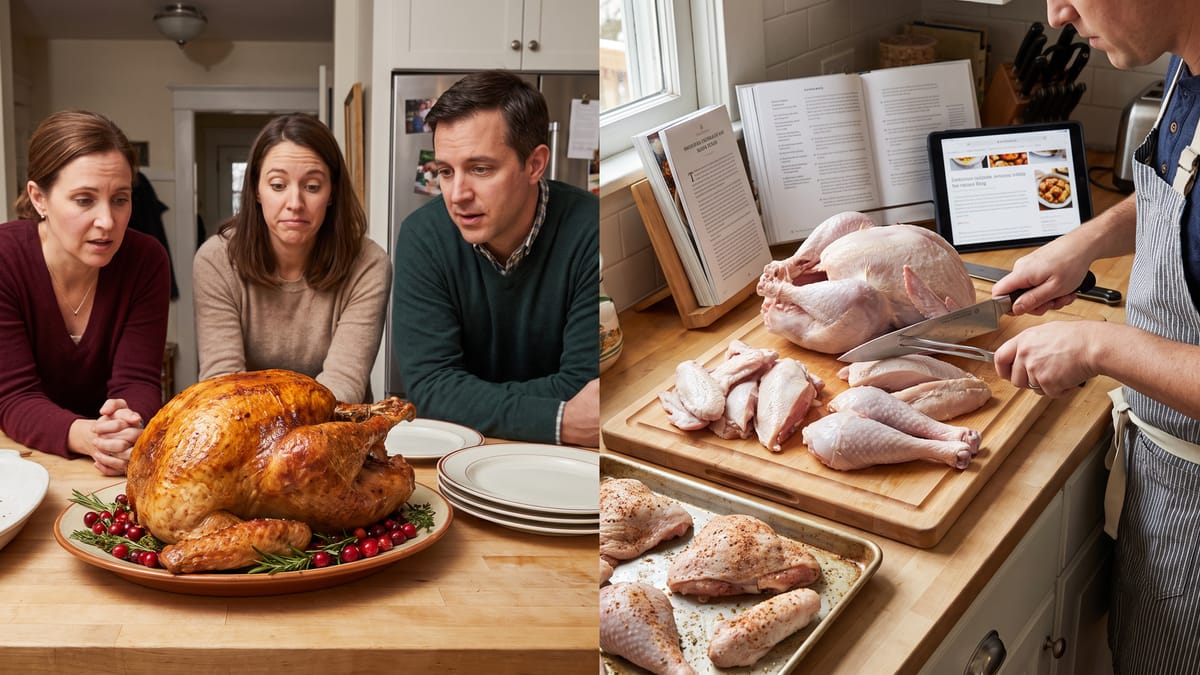
Should You Roast a Whole Turkey for a Small Crowd or Break It Down First
The aroma of roasting turkey is undeniably evocative, a sensory shortcut to holidays and gatherings. For many of us, the image of a perfectly burnished, whole turkey taking center stage is the epitome of festive feasting. But what happens when your guest list shrinks from a grand assembly to a more intimate affair? The notion of wrestling a massive bird into a modest oven, only to face a mountain of leftovers, might feel less like a celebration and more like a culinary chore. This brings us to a crucial question for the discerning home cook: should you still commit to roasting an entire turkey for a small crowd, or are there smarter, more efficient strategies that yield superior results?
We're going to dive deep into three primary approaches for preparing your holiday bird, weighing the practicalities, the delicious outcomes, and, crucially, the food safety considerations. Our goal is to equip you with the knowledge to make an informed decision, ensuring your turkey is not just safe, but also exceptionally flavorful and perfectly cooked, regardless of your guest count.
The Traditional Whole Roast: Comfort and Leftovers Galore
For generations, the whole roasted turkey has been the undisputed star of holiday tables. Its visual appeal is undeniable, a golden-brown masterpiece that elicits gasps of admiration. For a small crowd, the argument for roasting a whole bird often hinges on the desire for those classic, comforting leftovers. Think turkey sandwiches piled high, hearty soups, or rich casseroles that stretch the holiday joy for days.
However, the traditional whole roast comes with its own set of challenges, particularly for smaller gatherings. Achieving even cooking throughout a large, irregularly shaped bird is notoriously difficult. The breast, being leaner, tends to cook faster and dry out before the denser dark meat in the thighs and drumsticks reaches its ideal temperature. The USDA mandates that all poultry must reach a minimum internal temperature of 165°F (74°C) for safety. To ensure the dark meat is safe and tender, the breast often sacrifices its juiciness, sometimes becoming disappointingly dry. While pulling the turkey when the thickest part of the breast reaches 160°F and allowing carryover cooking to bring it to 165°F helps, it's still a delicate balancing act.
Furthermore, a whole turkey demands significant oven real estate. If you're also juggling multiple side dishes, fitting everything in can become a culinary Tetris game. And, while leftovers are a cherished part of the holiday experience, an abundance of them for a small group can become overwhelming. We must also remember the food safety guidelines: cooked turkey must be refrigerated within two hours of cooking, or within one hour if the ambient temperature is above 90°F. Managing a large volume of hot turkey to cool it down quickly and safely can be a logistical challenge in itself.
The Spatchcock Revolution: Faster, Crispier, Evenly Cooked
Enter the spatchcock method, a technique that has gained immense popularity among chefs and home cooks alike for its transformative results. Spatchcocking involves removing the turkey's backbone and flattening the bird, allowing it to cook more evenly and significantly faster. This method isn't just a culinary fad; it's a game-changer.
By flattening the turkey, the dark meat and white meat are exposed to the heat more uniformly, drastically reducing the chances of the breast drying out while the legs are still undercooked. The increased surface area also means more glorious, crispy skin, a coveted prize for many. The most compelling benefit, however, is the dramatic reduction in cooking time. Spatchcocking can cut roasting time by approximately 50% compared to a whole roast turkey. Some methods, like Mark Bittman's technique of roasting a spatchcocked turkey at 450°F, can cook a 10-pound bird in about 45 minutes, representing roughly a 75% time savings over traditional whole-bird roasting. This speed is invaluable when you're pressed for time or simply eager to get dinner on the table.
Beyond speed and evenness, a spatchcocked turkey lies flat, occupying less vertical space in your oven. This can be a huge advantage if you're working with a smaller oven or need to roast multiple dishes simultaneously. For a small crowd, a spatchcocked bird offers the best of both worlds: a beautifully cooked, juicy turkey without the extended cooking time or the uneven results often associated with a whole roast. And yes, you still get delicious bones for stock later.
The Precision Play: Breaking Down for Optimal Doneness
For the ultimate control over doneness, separating the turkey into its primary parts – breasts, thighs, and drumsticks – before cooking is the most precise strategy. This approach acknowledges a fundamental culinary truth: white meat and dark meat have different ideal cooking temperatures. White meat, particularly the breast, is best when cooked to a slightly lower temperature to retain its succulence, while dark meat benefits from a higher temperature to break down connective tissues and achieve tender, flavorful results.
With this method, you can pull the breast meat when it reaches an internal temperature of 150°F (66°C), which is safe when held at that temperature for at least 15 minutes, while the legs and thighs continue cooking to 170°F (77°C) for optimal tenderness. The legs and thighs, meanwhile, can continue cooking until they reach a more robust 170°F (77°C), ensuring they are perfectly tender and juicy. This level of precision is almost impossible to achieve with a whole bird.
Cooking in parts also offers incredible flexibility. You can choose to cook the pieces in the oven, on the stovetop, or even on the grill, depending on your preference and available equipment. For a small gathering, you might even consider purchasing specific parts rather than a whole bird. Bon Appétit suggests aiming for 2 pounds of turkey per person if you desire leftovers. Instead of a large whole turkey, you could roast two single breasts or a small breast plus legs. Serious Eats further advises using two smaller birds rather than one large turkey for better temperature control, oven fit, and more even cooking, a principle that extends beautifully to cooking in parts.
This strategy also makes managing leftovers more straightforward. While the USDA recommends cooking poultry to 165°F internally, cooking the breast to 150°F and holding it there for at least 15 minutes is also considered safe; leftovers must be refrigerated promptly, and having smaller, separate pieces can facilitate quicker cooling. Plus, you can prioritize using the white meat first, as it tends to dry out faster than dark meat. Save the legs and thighs for heartier dishes like braises, chili, or pot pie, and, of course, the carcass from any butchered bird makes for an exceptional stock.
Putting It All Together: Our Recommendation
After weighing the culinary science, practicalities, and food safety imperatives, our clear recommendation for a small crowd leans heavily towards breaking down the turkey rather than roasting it whole.
For most home cooks, spatchcocking offers the ideal balance of convenience, speed, and exceptional results. It dramatically reduces cooking time, yields more evenly cooked meat, and produces that coveted crispy skin. It also fits better in most home ovens, leaving precious space for those essential side dishes.
If you are a highly meticulous cook who prioritizes absolute perfection for each type of meat, then fully separating the breast and legs to cook them to their ideal, distinct temperatures is the superior choice. This method ensures every bite, whether white or dark, is at its peak juiciness and tenderness.
While the traditional whole roast holds sentimental value, its drawbacks for a small gathering, particularly uneven cooking and extended oven time, generally outweigh its benefits. If the desire for ample leftovers is paramount, consider purchasing two smaller turkeys and spatchcocking them, or simply buying specific parts like a whole breast and extra legs. Remember, air-drying a brined turkey uncovered in the refrigerator for 8 to 24 hours before roasting, regardless of the method, will always contribute to that irresistibly crispy skin.
Ultimately, the goal is a delicious, safe, and stress-free holiday meal. By embracing these modern, chef-approved techniques, you can ensure your turkey is the star of your small gathering, perfectly cooked and utterly memorable, without the traditional fuss.
Sources
- • Thanksgiving turkey tips from chefs and a dietitian
- • Whole, Spatchcocked, or Turkey Breasts: How to Choose
- • The Food Lab's Definitive Guide to Buying, Prepping, Cooking, and ...
- • Roast Spatchcock Turkey Recipe - NYT Cooking
- • How to Cook a Turkey in Parts
- • How Much Turkey Do You Need Per Guest at Thanksgiving?
- • Thanksgiving Turkey