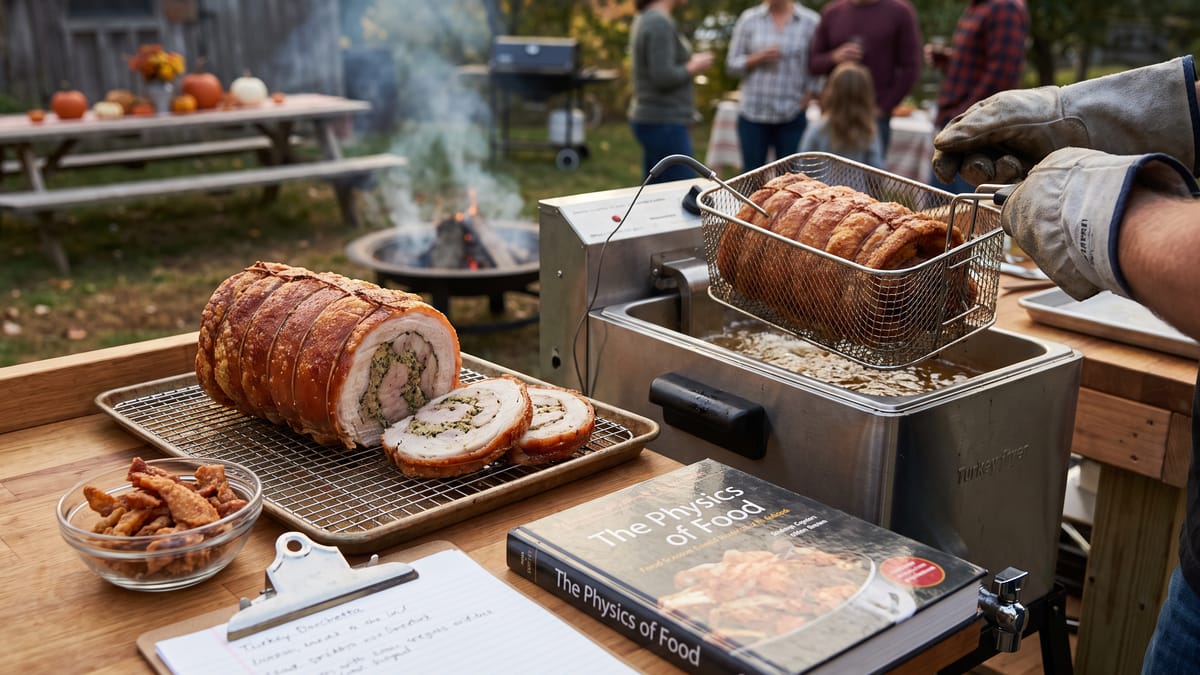
Should You Deep-Fry Your Thanksgiving Turkey Porchetta? The Science Behind the Crunch
Thanksgiving is a time for tradition, family, and, let's be honest, culinary ambition. Every year, we strive to elevate our holiday feast, pushing the boundaries of what's possible in our home kitchens. This year, a tantalizing question has been simmering in many of our minds: Should we deep-fry our Thanksgiving turkey porchetta? It's a bold concept, marrying the irresistible allure of crispy fried poultry with the elegant, deboned, and rolled turkey porchetta. But beyond the sheer novelty, what does food science tell us about this audacious endeavor? Let's dive deep into the crunch, the flavor, the safety, and the undeniable science behind choosing between deep-frying and traditional roasting for this show-stopping centerpiece.
The Allure of Turkey Porchetta
Before we even consider cooking methods, let's appreciate the brilliance of turkey porchetta itself. A whole turkey, while iconic, often presents a challenge: dry breast meat by the time the dark meat is cooked through, and a skin that can be less than uniformly crisp. Turkey porchetta, typically a deboned turkey breast rolled in its own skin, solves these problems beautifully. By creating a uniform cylinder, it cooks more evenly, whether roasted or fried, ensuring succulent meat throughout. This innovative preparation gives us a perfect canvas to explore the ultimate crispy skin.
Deep-Frying: The Science of Accelerated Crispness
The promise of deep-frying is undeniably appealing, especially when we crave that shatteringly crisp exterior. The science behind this lies in the fundamental differences between oil and air as heat transfer mediums. Oil's thermal conductivity and heat capacity are vastly superior to air's. This means hot oil can transfer heat to the food much more rapidly and uniformly than hot air in an oven.
When turkey porchetta hits hot oil, typically around 375°F (191°C), several critical reactions occur almost instantly. The intense, even heat drives surface moisture away at an astonishing rate. Simultaneously, the Maillard reactions, responsible for that coveted browning and complex flavor development, kick into high gear. These reactions, which occur between amino acids and reducing sugars at temperatures above 280–300°F, are accelerated in the high-heat environment of the oil. The result is faster, more even browning and a significantly crispier skin compared to roasting. A 15-pound bird, for instance, can be deep-fried in roughly 45 minutes, a stark contrast to the 3–4 hours it might take to oven roast. This rapid cooking also helps reduce overall moisture loss from the meat by shortening the time it spends in the heat.
However, this efficiency comes at a cost, both literally and in terms of safety. Deep-frying can add a substantial amount of absorbed oil, often 5–40% of the food's weight, significantly increasing its fat content.
The Roasting Counterpart: A More Controlled Crisp
Traditional oven roasting offers a different path to crispness, one that is generally more familiar and less intimidating for the home cook. While the heat transfer from air is slower than from oil, a well-roasted turkey porchetta can still achieve a beautiful, golden-brown, and reasonably crisp skin. The process is more gradual, allowing for careful monitoring and adjustments.
Roasting relies on convection, where hot air circulates around the food, gradually heating its surface. To achieve optimal crispness in the oven, we often employ techniques like starting at a higher temperature to kickstart browning, then reducing it to ensure the interior cooks through without burning the exterior. Basting with pan drippings or butter can also contribute to flavor and color, though it can sometimes hinder ultimate crispness if applied too frequently. While roasting takes considerably longer, it is inherently safer, eliminating the risks associated with large volumes of superheated oil.
For those who want a quicker, lower-risk alternative to deep-frying but still crave a pan-fried crisp, pan-roasting turkey porchetta in a skillet with about 2 tablespoons of oil over high heat takes roughly 10 minutes total to brown all sides. This offers a middle ground, providing a lovely crust without the full commitment or danger of a deep fryer.
Safety First: The Non-Negotiable Reality of Deep-Frying
This is where the conversation turns serious. While the crunchy allure of deep-fried turkey porchetta is undeniable, the safety considerations are paramount and cannot be overstated. Deep-frying, especially with large volumes of oil, carries significant fire and burn risks.
The most critical hazard stems from water or ice contacting hot oil. Even a small amount of moisture on the turkey surface causes explosive vaporization when it hits oil at 350°F (177°C) or higher. Water expands approximately 1,700 times its volume when it turns to steam, ejecting hot oil violently and creating a severe fire hazard. This is why the turkey porchetta must be completely thawed and thoroughly dried before it ever goes near the fryer. Pat it down meticulously with paper towels, then let it air dry in the refrigerator for a few hours if possible.
Beyond moisture, equipment choice and setup are crucial. The National Fire Protection Association (NFPA) discourages outdoor gas-fueled turkey fryers due to several inherent dangers: tip-over risk, lack of thermostat controls (oil can easily overheat to combustion temperatures), and extremely hot handles and lids. Electric fryers without open flames are generally considered safer alternatives, as they often have built-in thermostats and are designed for more controlled operation. Always operate any fryer outdoors, away from combustible materials, and on a stable, level surface. Have a fire extinguisher rated for grease fires (Class K or B) readily accessible.
Equipment Considerations: What You'll Need
For Deep-Frying:
- • A Turkey Fryer: This could be an outdoor propane-fueled fryer (with extreme caution and adherence to all safety guidelines) or a safer electric indoor/outdoor model.
- • Large Pot/Basket: Sized appropriately for your porchetta.
- • Oil: Peanut, canola, or vegetable oil are common choices due to their high smoke points. You'll need a significant volume.
- • Long-Handled Tongs/Gloves: For safely lowering and retrieving the porchetta.
- • Meat Thermometer: Essential for checking internal temperature.
- • Fire Extinguisher: A non-negotiable safety item.
- • Roasting Pan with Rack: To allow air circulation around the porchetta.
- • Oven: Standard kitchen appliance.
- • Meat Thermometer: Crucial for doneness.
- • Twine: For tying the porchetta.
The Internal Doneness Debate: Sous Vide's Role
Regardless of the external crisping method, ensuring the turkey porchetta reaches a safe internal temperature is paramount. The USDA recommends cooking turkey to a minimum internal temperature of 165°F (74°C). However, modern food science and techniques like sous vide offer an alternative path to equivalent pasteurization.
Sous vide cooking, where food is cooked in a precisely temperature-controlled water bath, allows for much lower cooking temperatures over longer periods to achieve the same safety profile. For instance, cooking turkey at 140°F (60°C) held for sufficient time, such as 30+ minutes, achieves equivalent pasteurization. This method virtually eliminates the risk of overcooking, resulting in incredibly juicy, evenly cooked meat with minimal temperature gradient from edge to center.
A truly gourmet approach, combining the best of both worlds, involves a sous-vide-then-deep-fry method. Cooking turkey porchetta sous vide at 140°F (60°C) for 4–5 hours ensures a perfectly tender, juicy interior. After its sous vide bath, the porchetta can be thoroughly dried and then deep-fried at 350°F (177°C) for a relatively short period to develop that deeply crisp, golden crust. This two-stage process yields a juicy interior with unparalleled precision and a maximum crust, and the meat can even be sliced immediately after frying since the internal cooking is already complete. This approach, however, demands specialized equipment: a sous vide immersion circulator and a water bath.
Putting It All Together: The Verdict
So, should you deep-fry your Thanksgiving turkey porchetta?
The scientific evidence is clear: Deep-frying turkey porchetta produces faster, more even browning and a significantly crispier skin due to oil's superior heat transfer capabilities. The rapid, intense heat of the oil accelerates Maillard reactions and drives off surface moisture more efficiently than air. However, this method carries significant fire and burn risks that necessitate strict safety protocols, including ensuring the turkey is completely thawed and dry, operating the fryer outdoors on a stable surface, and having appropriate fire suppression ready.
Roasting, while taking longer and potentially yielding less uniform crispness, is undoubtedly safer and more accessible for the average home cook. It's a reliable method that, with attention to detail, can still produce delicious results.
For the adventurous and safety-conscious cook seeking the ultimate texture, the sous-vide-then-deep-fry approach is scientifically superior. It combines the precise internal doneness and juiciness of sous vide with the unparalleled crust development of deep-frying, though it does require specialized equipment and a commitment to meticulous execution.
Ultimately, the choice depends on your comfort level with risk, your equipment, and your desired outcome. If you prioritize safety and ease, roasting is a perfectly respectable and delicious choice. If you are experienced with frying, understand and mitigate the risks, and crave that truly exceptional, shatteringly crisp skin, deep-frying your turkey porchetta, especially after a sous vide bath, can be a game-changer. Just remember, a delicious holiday meal is only truly successful when everyone is safe.