Do Bay Leaves Actually Do Anything? The Simple Test That Settles the Debate
The humble bay leaf, a seemingly innocuous dried curl often found lurking in the spice cabinet, has long been a culinary enigma. For some, it is an indispensable aromatic, a secret weapon that imparts a subtle, almost indescribable depth to stews, soups, and sauces. For others, it is nothing more than kitchen folklore, a dried relic whose presence adds precisely zero discernible flavor, destined only for polite removal before serving. We have all heard the fervent declarations from both camps, the passionate defenses and the dismissive eye-rolls. So, who is right? Does this unassuming leaf truly pull its weight in the pot, or is it merely a culinary placebo, a vestige of tradition with no real impact? Let us dive into the heart of this aromatic debate and, with a simple test, settle the matter once and for all.
The Great Bay Leaf Divide: Placebo or Potent?
On one side of the simmering pot, we find the staunch advocates, the cooks who would no sooner omit a bay leaf from their bolognese than they would forget the salt. They speak of a certain "roundness," a "deepening" of flavor, a "je ne sais quoi" that elevates a dish from merely good to truly sublime. They might describe it as a faint tea-like note, a whisper of pine, or a delicate floral undertone. For these culinary traditionalists, the bay leaf is a foundational layer, a silent orchestrator that harmonizes the other ingredients without ever stealing the spotlight. They will tell you that while you might not immediately identify "bay leaf" as a distinct flavor, its absence would leave a noticeable void, a dish feeling somehow incomplete or flat.
Then, there are the skeptics, the culinary empiricists who approach the bay leaf with a healthy dose of doubt. They have simmered it, steeped it, and even chewed it, often concluding that it tastes like, well, nothing much at all. For these cooks, the bay leaf is a culinary superstition, an ingredient used out of habit rather than conviction. They might argue that any perceived flavor is simply the power of suggestion, a trick of the mind influenced by generations of recipe instructions. They are often quick to point out that in a complex dish, with many strong flavors vying for attention, a subtle bay leaf would surely be overwhelmed, its delicate contribution lost in the culinary cacophony. This division, born of differing perceptions and experiences, highlights the very core of our inquiry.
Unpacking the Aroma: The Science of Bay Leaf Flavor
To understand whether bay leaves truly do anything, we need to delve into their aromatic chemistry. The primary volatile compound responsible for the bay leaf's characteristic scent and flavor is 1,8-cineole. If that name sounds familiar, it is because 1,8-cineole is also found in eucalyptus and camphor, lending a medicinal, minty, almost Vicks VapoRub-like aroma. This compound, along with others present in smaller quantities, is what gives bay leaves their unique herbaceous profile.
However, here is where it gets interesting, and where some of the debate likely stems from: not everyone perceives 1,8-cineole in the same way. A 1981 study revealed that approximately one-third of participants could not taste this key compound, suggesting a genetic selective anosmia for bay leaf flavor. This means that for a significant portion of the population, the subtle notes that others detect might simply be imperceptible. It is not a matter of a poor palate, but rather a difference in genetic makeup. So, if you are one of those who struggles to taste bay leaf, it is not your fault, it is your genes.
Beyond genetics, the effectiveness of bay leaves is also heavily influenced by how their volatile compounds are extracted. Most of these compounds are not particularly water-soluble. They tend to extract best in oil or a fatty base, such as a béchamel sauce or a rich stew. This is why bay leaves truly shine in long-simmered dishes where they have ample time to release their aromatics into a fatty liquid, rather than in a quick boil of plain water. They act as a supporting flavor layer, rounding and deepening other ingredients, much like how a mirepoix forms the aromatic foundation of many dishes without necessarily being a "named" flavor itself. Their role is to enhance, to add complexity, not to dominate.
Fresh Versus Dried: The Potency Paradox
Another critical factor in the bay leaf's perceived efficacy is its freshness. We often buy dried bay leaves and store them indefinitely, assuming they will retain their potency. Unfortunately, this is not the case. Dried bay leaves lose their volatile compounds over time. If you crush a dried bay leaf from your spice rack and find it has little to no aroma, it has likely lost most of its flavor-contributing compounds and should be replaced. Think of it like a wilted herb, past its prime.
Fresh bay leaves, on the other hand, are significantly more potent. They offer a much more vibrant, pronounced aroma and flavor. This difference was clearly demonstrated in a side-by-side blind tasting of chicken stock, where testers consistently detected a more herbal, nuanced flavor in stock made with a fresh bay leaf compared to stock made with no leaf or even dried leaves. The freshness factor is paramount. Aim for dried leaves that are less than one to two years old for the best results.
It is also worth noting that not all bay leaves are created equal. The bay leaves most commonly found in American supermarkets are typically Mediterranean or Turkish bay leaves (Laurus nobilis), which have a milder, more subtle flavor. California bay leaves (Umbellularia californica), while less common, are significantly more pungent, with stronger eucalyptus and camphor notes. If you have only ever tried the milder variety and found it lacking, seeking out a California bay leaf might be an eye-opening experience.
The Simple Test That Settles the Debate
Now, for the moment of truth. How can you, in your own kitchen, determine if bay leaves actually do anything for you? The answer lies in a simple, controlled experiment that requires minimal effort and no special equipment. This test is designed to isolate the bay leaf's contribution, removing other strong flavors that might mask its presence.
The Hot Water Aroma Check:
This is the quickest way to gauge the potency of your bay leaves and your ability to perceive their flavor.
- 1. Gather your leaves: Take a few dried bay leaves from your current supply. If you have access to fresh bay leaves, even better, include one.
- 2. Prepare two cups: Fill two identical mugs or small bowls with very hot water, just off the boil.
- 3. Infuse one: Place one bay leaf (or a small piece of a fresh one) into one of the mugs. Leave the other mug plain.
- 4. Steep and sniff: Let the bay leaf steep for about 5-10 minutes. Then, remove the leaf and take a deep sniff from both mugs. An informal office experiment found that every colleague could identify the bay-leaf-infused water. Do you detect a difference? A subtle medicinal, minty, or herbaceous aroma in the bay leaf mug?
The Side-by-Side Simmer Test (The Ultimate Verdict):
This test is a bit more involved but provides a much clearer picture of the bay leaf's impact in a cooked dish. America's Test Kitchen finds bay leaves most noticeable and necessary in simple, long-simmered broths and dishes with fewer competing strong flavors.
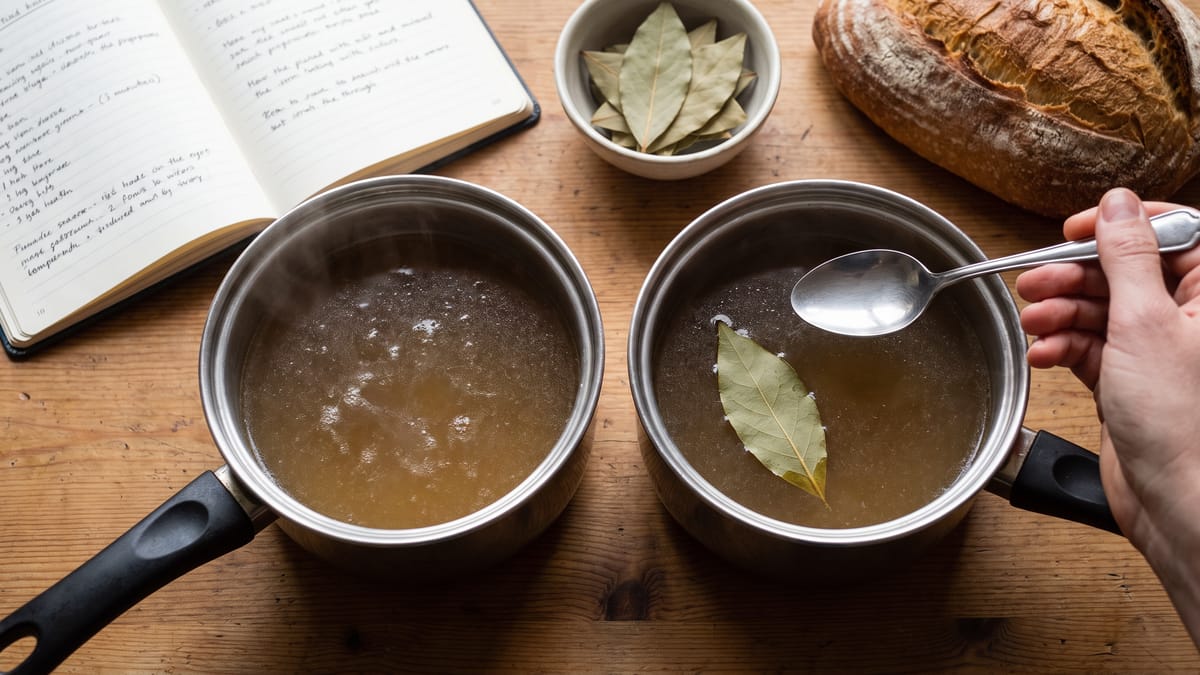
- 1. Choose a simple base: The ideal candidate is something like a basic chicken stock, vegetable broth, or a simple bean stew. You want a liquid that will simmer for at least an hour, allowing the bay leaf to fully infuse.
- 2. Divide and conquer: Prepare two identical batches of your chosen base. Use the exact same ingredients, quantities, and cooking times for both.
- 3. The bay leaf addition: To one batch, add 1-2 fresh or relatively new dried bay leaves. To the other batch, add nothing.
- 4. Simmer and taste: Let both batches simmer for the recommended time. When they are done, remove the bay leaves from the infused batch.
- 5. Blind taste test: This is crucial. Ask a friend or family member to serve you small, unlabeled portions of each batch. Without knowing which is which, taste each one carefully. Focus on the overall depth, complexity, and any subtle aromatic differences.
Putting it All Together
So, do bay leaves actually do anything? The evidence, both scientific and anecdotal, strongly suggests that yes, they do. They add a subtle, herbaceous depth, often described as tea-like, piney, or slightly floral, to long-simmered liquids. However, their effect is easily missed if the leaves are old and devoid of volatile compounds, if the variety is mild, or if the taster happens to be one of the roughly one-third of people who cannot perceive the key compound 1,8-cineole. Fresh leaves and newer dried leaves are far more potent, and their flavors extract best in fatty liquids over time.
Ultimately, the bay leaf is not a showstopper ingredient. It will not announce its presence with a fanfare of flavor. Instead, it is a quiet contributor, a background player that works tirelessly to round out and deepen the overall profile of a dish. It is a testament to the subtle art of layering flavors, proving that sometimes, the most profound impacts come from the most unassuming sources. The simple tests outlined above will allow you to discover for yourself the true, understated magic of the bay leaf, and perhaps, finally settle the debate in your own kitchen.
Sources
- • Do bay leaves actually add flavor, or is it all a con?
- • Do Bay Leaves Actually Do Anything? (Yep, Here's Why)
- • A Chef Finally Settles the Debate: Do Bay Leaves Even Do ...
- • What Do Bay Leaves Actually Do?
- • Solving the great bay leaf controversy – all in the interests of science
- • Do bay leaves actually make a difference to a recipe?
- • Are Bay Leaves a Big, Fat Scam?